|
I borrowed the neighbor's ladder to clean out my rain
gutters to help prevent the possibility of more water in
my basement like the one-inch high pool in the corner of
one room earlier this spring when we had heavy rains. While I had the ladder, I climbed onto the
roof of my one-story house and photographed my back
yard. The camera faces east, northeast. My property ends
at the chain link fence on the far edge of the photo. My
lot is 15,400 square feet, and the area of vegetable and
fruit production is probably one tenth of an acre. At the back of the lot
is an old Concord grape vine that was there when I
bought the property in 2006 and a patch of Polana
raspberries that I planted in 2007. There is also a
raspberry bed in the lower left hand part of the
photo. I planted it in 2008.
Last year, I had several small beds, each with a
chicken wire fence around it. This year, a college
student friend of mine, Jonathan, and I worked together for a day, using a lot of
my accumulated collection of wire, to create a fence
around the circumference of the whole area my main
garden. See the white tops of the steel posts in the
front and far left hand corners. |
|
 |
When I stood on the roof to view the garden, I was
surprised at what a small percentage of the garden
seemed to be developed. After all, I had spent many
hours during many previous days and weeks with shovel
and on hands and knees working the soil to make beds and
transplant seedling or sow seeds. |
|
The photo is somewhat of an optical allusion. The brown
of the meandering wood chip paths blend in with the
lasagna-layered beds that I established last fall and
the patches where I had planted potatoes and covered
them with a light layer of straw this spring. Actually,
I felt good that there was so little openly-tilled,
black soil and that so much of the garden was covered
with mulch. That's much different than a lot of agriculture and traditional gardening in Iowa. I
didn't get as many lasagna beds established as I would have
liked last September. So in March, I built
another one, putting down manure that I had carted home
last fall, then covering it with straw, leaves,
newspaper and cardboard and weighing the layers down
with boards. Some of the wood had been part of a wheel chair ramp
for a previous owner of my home. Some was from the bounty of loft
beds that I collected at the university residence halls
at spring checkout time
in 2007. The system worked OK, but in spite of using the
wood for ballast, the strong spring winds tore at some
of the cardboard, shifting the bed out of its original
position. |
 |
Just this week, I had gotten my order of basil, bell
peppers, and tomatoes from Lonna of Onion
Creek Farm and was glad the beds were ready. Within a
day, I had all of her plants planted. That night, I
read my copy of The Garden Primer and realized
that peppers don't like cold weather. But the plants
were already in the ground. |
|
It was hard to know whether or not to add protection to
the peppers with the prospects of temperatures getting
down to around 40 in the next few days. Fortunately,
Jonathan had helped me cut the bottoms off of several
plastic, gallon milk jugs, and I put one over each plant
as a miniature green house. When I was living in Gilbert but looking for a home in
Ames, I wanted a yard big enough to plant at least one
apple tree and a small garden. So it is with awe that I
think that I ended up with this large of yard that is so
open to sunshine. The tree in the photo is
one of two cherry trees that I bought and planted in
2007. But my greatest tree success story is that I had learned
to graft apple trees in 2006 and have six trees growing in my yard
that are a result of my grafting efforts. Four were started with scion wood from a
83-year-old Wealthy tree at the abandoned farmstead
where my grandparents' had lived. The other two are from a
Sweet 16 tree at the home of friends near my hometown.
Although I have a large garden, I feel like I am running
out of space. A friend had given me some spinach seed,
but I was reluctant to grow it because I am more a fan
of kale and collards, and I didn't want to take up
precious ground space with spinach. So I put spinach
seed
in pots that I had used in my container garden on my
apartment deck in Gilbert. I anticipate that after I
pick the spinach, it will be about the time when more
soil needs to be mounded over the potato patches, and I will
be able to use the soil from the pots for the job. |
 |
I like kale—the taste, nutritional aspects, and ease of
use. Also, kale provides a
continuous source of great greens during the growing
season. It's not like cabbage where a gardener waits
until there is one mature head, if fortune allows, then
picks it, and the plant is done. Last fall, I asked
advice of many people about how to extend the season of
my kale plants or perhaps over-winter them. In March or
so, I thought my efforts were for naught. The plants
appeared to be totally dead—the remaining stems white
with no green color.
But a few others
actually came to life. What a pleasant surprise. |
|
I noticed this past week that the kale plants were starting to make
little balls and were either beginning to flower or seed. I
was afraid they might bolt like cilantro, and their
growth would be done. But I guess they will continue to
grow, and if they flower and seed, I may have a somewhat
wild patch that will naturally come back each year. It
wasn't until last year that I first got an inkling of
what a biennial plant is when I was reading about
carrots and beets. Apparently, if left in the ground
over the winter and able to grow a second season, they
will produce flowers and seeds. Hopefully that will
happen with a couple of my kale beds. Speaking of carrots,
my friend Gary of Growing Harmony Farms
southeast of Ames says that one of his secrets to
growing carrots is to cover the seed bed with burlap and
keep it moist until the carrots have germinated. I
tried that with carrot and beet seeds this
spring. So far, the beets are doing fine. But I haven't
seen signs of success with the carrots. Perhaps I will
simply let Gary grow carrots for me. He is renowned
throughout the state for his carrots. But even so, I
have this notion that I must at least make a good
attempt to prove to
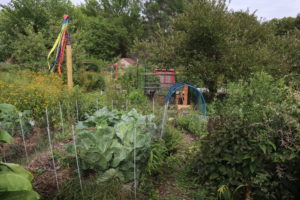
myself that I can grow carrots. The burlap bag and its
artwork, such as a colorful parrot, also add character
to the garden. |
 |
Another important book is Gaia's Garden about
permaculture. It is critical of how so many gardeners
replicate the row crop model of agriculture and
recommends small patches with a mixture of
plants in order to work with nature. Instead of a huge bed of cabbage and letting the
predators consume it with no competition, put one
cabbage plant here and another there. |
|
I don't understand plant life, or nature in general, well enough to be a full
devotee of permaculture, but I do have small beds and
more than one variety of each vegetable for
diversity. |
 |
This is the second year that I have grown garlic,
planting the cloves last fall in four patches. Three in
my backyard, and one next to my driveway in the front
yard. The garlic will be ready to harvest in early July,
then I will be able to plant something else in its
place—perhaps more beets, kale, or collards. Or maybe I
can let a bed lie fallow and begin to build lasagna
layers for 2010. |
|
When I first moved here, there was a garden over-run
with weeds at the back of the lot by my neighbor's hedge
on the north (the left side of the photo below). The previous owners let me come, even
before we closed my purchase of the house on June 16, 2006, so that
I could begin to weed. Oh, there was a ton of Creeping
Charlie to pull out. On Memorial Day weekend, I
planted asparagus. |
|
 |
Later I transplanted rhubarb from a shady spot on the
other side of the lot to the area, planted
strawberries, and added one of the Wealthy apple trees
that I grafted. Steve, who calls himself
The Garden Assistant, helped put up the fence. The
wooden posts in the corners are ones I
redeemed from a pile in the grove at
my grandparents' farm. |
|
I am glad this is the fourth year of the asparagus patch
so that I can pick as much as I want, but there hasn't
been the bounty I had hoped for—at least, not yet.
I saw Gary at a block party Saturday night for
several graduating sustainable agriculture students. He
said that each year in July, he begins piling lots of
manure and other organic matter on his asparagus beds. I
guess I will do that this year. The strawberry plants
have certainly rambled. I don't know if they are going
to be too much
competition for the asparagus. The
rhubarb is thriving, seemingly unaffected by the
rambling strawberries, and I have already consumed some
and shared others with friends. Tonight, my heart sank
when I saw that my neighbor was spraying her turf to
kill violets and maybe Creeping Charlie on the other
side of the hedge. I had known she was going to spray in
other areas such as near the side walk. It's a long
story, but here's the essence. She had supposedly done
her research by talking to the neighbor across the
street who knows a lot about horticulture and the folks
at Earl May, moved with her hose and sprayer to the back
yard in the area near the hedge which which is close to
our boundary line and, at most, 10 feet away from my
rhubarb, strawberries, and asparagus. I expressed concern, she said there would
be no risk to my garden, I plucked some blades of grass
to test the wind direction, there was a breeze coming
directly south—in other words, directly toward my
garden, but she was at a distance from me and intent on
getting the job done.
I called my horticulture-wise neighbor, Joan, across the street. She was on a tight
schedule, preparing
for a demanding week. But she had a sliver of
time to talk. She said that there must have been some
misunderstanding, there had been a wind, she had smelled
chemicals, it had not been a good
time for spraying, and the only thing I could do was to
hose down my garden. I had not used city water in my
garden yet this year because I have four, 50-gallon rain
barrels that generally serve my outdoor watering needs. But
I carry water from them in watering cans, and the
barrels do not
provide much pressure. In other words, they would be of
little use for the job at hand. I went to the basement and opened
the valve for the outdoor hydrant, got out my hoses, and
borrowed one from Joan. Perhaps I averted a problem.
However, I had intended to pick a few stalks of
asparagus for supper, and my neighbor's spraying
activity ruined any desire to do so. I also wondered how
soon I would be able to have friends come again and pick
from my bounty of
rhubarb.
For the most part, my neighbor who did the spraying and I get along well, but I guess we have
things to work things out regarding the use of chemicals. The incident
was a grim reminder of how pervasive chemicals are in our society. I
think of all the springtime ads from lawn companies and
the nearby hardware store for chemical lawn treatments
and how so many people view their turf as a throne. I
guess that's another way that I am in tune with the book
Gaia's Garden. I care about growing healthy food
here and am fine with a natural yard. Yes, I like
tidiness and wonder how I am going to keep my turf in
halfway decent condition when I am using most of my
ambition and time to grow vegetables. But certainly, I
do not want a pristine lawn. |
|